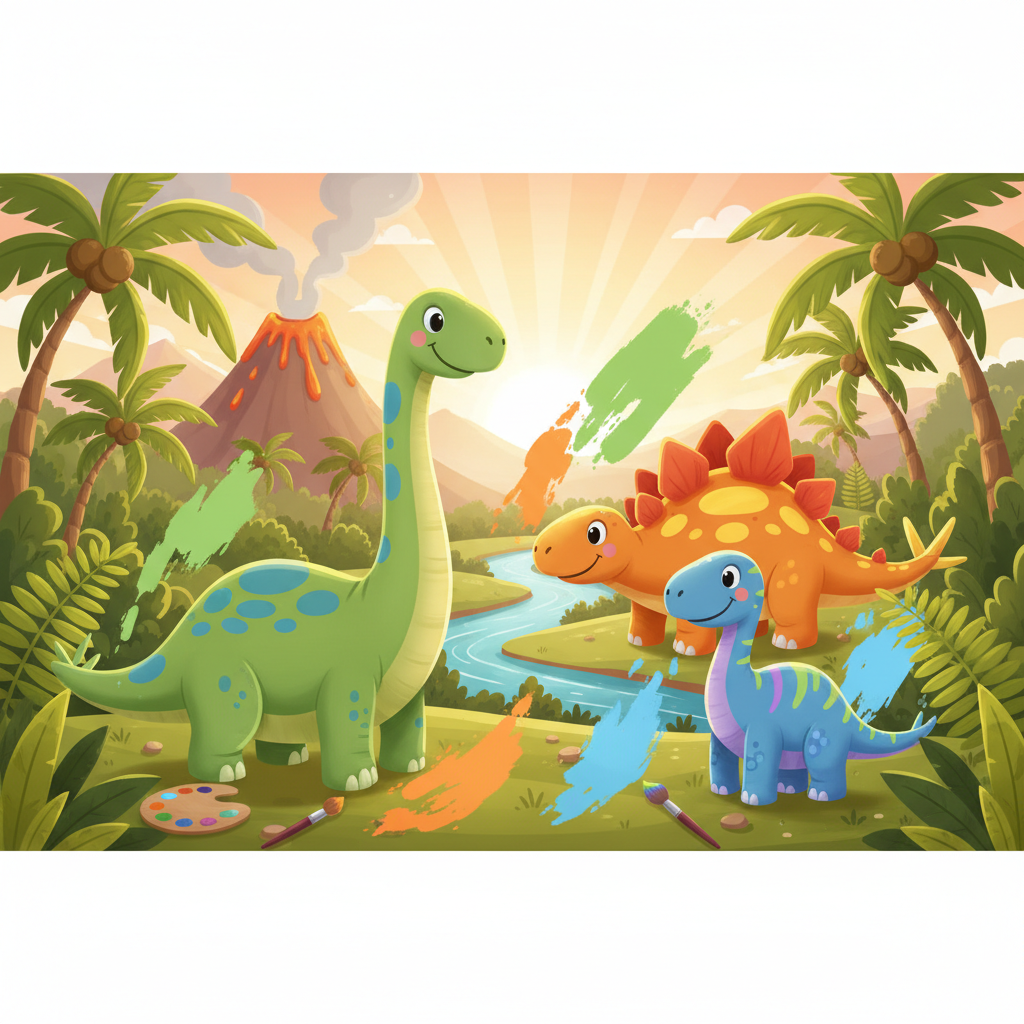
Imagine your favorite dinosaur coming to life under your crayons! Have you always dreamed of giving incredible colors to a T-Rex or a Triceratops? This guide is for you! We'll learn together how to color a realistic dinosaur, using simple and fun techniques. Prepare your crayons, felt-tips or pastels, and let your imagination run wild! Learning, creating and having fun, that's the secret to a good coloring!
🦕🦖 Why turn your coloring into a realistic prehistoric adventure? 🦖🦕
Coloring is good, but coloring a realistic dinosaur is even better! Here's why:
- Learn while having fun: By choosing the right colors and observing the details, you'll discover a lot about dinosaurs. Did you know, for example, that some dinosaurs had feathers?
- Develop your creativity: Even if we try to make them realistic, you can always add your personal touch! Maybe your T-Rex will have original patterns or bright and amazing colors!
- Improve your concentration: Coloring requires patience and attention. It's an excellent exercise to help you concentrate and relax.
Fun fact: We often think that dinosaurs were all green or brown, but that may be wrong! Some scientists think they could have had bright and vibrant colors, like today's birds!
🎨 The basics of color: Become a prehistoric artist! 🎨
To color a realistic dinosaur, you must first understand the basics of color. Don't panic, it's simpler than it seems!
Primary colors: The stars of coloring!
These are the basic colors: red, yellow, and blue. You can't create them by mixing other colors.
Secondary colors: The fruit of mixing!
You get them by mixing two primary colors:
- Red + Yellow = Orange
- Yellow + Blue = Green
- Blue + Red = Purple
Shades, Shadows and Lights: Give relief to your dinosaur!
To give a realistic look to your realistic dinosaur coloring, you have to play with shades, shadows and lights. It's like sculpting with colors!
- Shades: These are the different variations of the same color (for example, from light green to dark green).
- Shadows: They are on the parts of the dinosaur that are not directly illuminated by light. Use darker colors to create them.
- Lights: They are on the parts of the dinosaur that are directly illuminated by the light. Use lighter colors to create them.
🌈 Dinosaur colors: Scientific truth or boundless imagination? 🌈
We have long imagined dinosaurs with dull and uniform colors. But recent scientific discoveries suggest that they may have been much more colorful than we thought!
Scientists have found fossilized pigments in dinosaur feathers, which allows them to reconstruct certain colors. We know, for example, that some small dinosaurs had black and white feathers, like today's magpies.
For dinosaurs without feathers, it's more complicated. We rely on the skin color of current animals, such as reptiles and birds, to imagine possible colors. But in the end, it's your imagination that counts! Don't hesitate to experiment and create dinosaurs with original and surprising colors! The important thing is to color a realistic dinosaur... or not!
🦖 Step-by-step guide: Transform your T-Rex into the king of the jungle (or the savannah)! 🦖
The T-Rex is the star dinosaur! Here's how to color a realistic dinosaur:
- Choice of colors: For a realistic T-Rex, you can use colors like brown, dark green, beige or gray. You can also add touches of brighter color, like red or yellow, on its crest or eyes.
- Application of shadows and lights: Imagine that the light comes from above. The parts of the T-Rex that are most exposed to the light (the top of the head, the back) will be lighter. The parts that are hidden (the belly, under the arms) will be darker.
- Pro tips: Use a dark brown colored pencil to draw the outlines of the T-Rex. This will give it more relief. You can also use a white pencil to create light reflections on its skin.
🛡️ Step-by-step guide: Give incredible colors to your Triceratops! 🛡️
The Triceratops, with its horns and frill, is an impressive dinosaur! Here's how to color a realistic dinosaur:
- Choice of colors: For a realistic Triceratops, you can use colors like gray, light brown, beige or olive green. You can also add brighter colors on its frill, like red, orange or yellow.
- Application of shadows and lights: As with the T-Rex, imagine that the light comes from above. The parts of the Triceratops that are most exposed to the light (the top of the head, the back, the top of the frill) will be lighter. The parts that are hidden (the belly, under the horns) will be darker.
- Pro tips: Use a black colored pencil to draw the outlines of the horns and frill. This will highlight them. You can also use a white pencil to create light reflections on its skin and horns.
🐾 Step-by-step guide: Transform your Velociraptor into a fearsome predator! 🐾
The Velociraptor, fast and intelligent, is a fascinating dinosaur! Here's how to color a realistic dinosaur:
- Choice of colors: For a realistic Velociraptor, you can use colors like brown, beige, gray, dark green or orange. You can also add patterns, like stripes or spots, to camouflage it in its environment.
- Application of shadows and lights: Shadows and lights are particularly important to give relief to its muscular and agile body.
- Pro tips: Use a black colored pencil to draw the outlines of its sharp claws. This will make them even more threatening. You can also use a white pencil to create light reflections on its eyes and skin.
Fun fact: The Velociraptor from the movie Jurassic Park is actually much larger than the real Velociraptor! The real Velociraptor was about the size of a turkey!
🖍️ Tools and materials: Become a coloring pro! 🖍️
To color a realistic dinosaur, you need the right tools:
- Colored pencils: Perfect for beginners, they allow you to create gradients and subtle shades.
- Felt-tips: Ideal for bright colors and precise outlines.
- Pastels: They allow you to create effects of texture and softness.
Don't hesitate to experiment with different types of pencils, felt-tips and pastels to find the ones that suit you best.
✨ Additional tips for a coloring worthy of a museum! ✨
Here are some tips to improve your realistic dinosaur colorings:
- Gradient techniques: Learn to blend colors smoothly to create realistic gradients.
- Use of stencils: Use stencils to create original and precise patterns.
- Color mixtures: Don't be afraid to mix colors together to create unique shades.
📚 Resources: Where to find free dinosaur coloring pages? 📚
Looking for models of realistic dinosaur coloring pages? Here are some sites where you can find them for free:
- [Insert here links to sites offering free dinosaur coloring pages]
🎉 Share your creations and become a coloring star! 🎉
So, ready to embark on the adventure of realistic dinosaur coloring? Remember, the important thing is to have fun and let your imagination run wild! Share your creations with us on social media with the hashtag #RealisticDinoColoring. We can't wait to see your prehistoric works of art! Who knows, maybe your coloring will be selected for our online gallery or our next contest!
Discover even more dinosaur coloring pages on our site and let your imagination take you into the fascinating world of giants of the past!