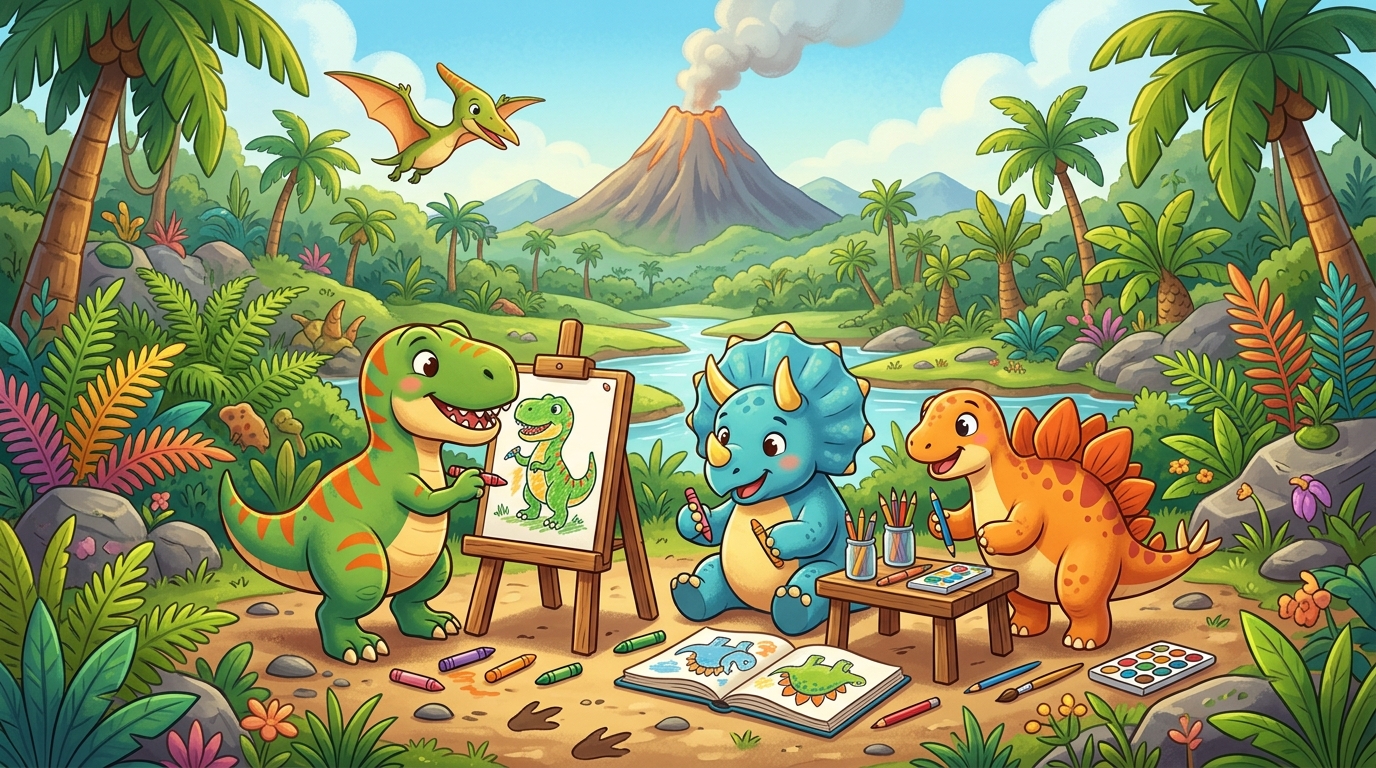
Dinosaurs aren't just giant creatures that dominated the Earth millions of years ago; they are the undisputed stars of children's imaginations! Who hasn't dreamed of seeing a T-Rex roar or a Triceratops grazing peacefully in their backyard? If you love prehistoric reptiles, you’ve surely already filled dozens of pages with markers. But today, we’re taking things to the next level. Are you ready to learn how to color a realistic dinosaur like a true paleontologist-artist?
Moving from "simple" coloring to a work of art that looks like it wants to jump off the page requires a bit of patience and a few pro tips. Whether you’re a budding little artist or a parent looking for a creative activity, this guide is for you. Grab your pencil cases, we're heading on an expedition into the world of realism!
The Little Explorer’s Toolkit: Equipment for Stunning Results
To successfully color a realistic dinosaur, choosing the right equipment is essential. Forget standard markers that bleed through the paper: to create volume and nuance, nothing beats quality colored pencils.
Why colored pencils are your best allies
Unlike markers, which offer a flat color, colored pencils allow you to layer shades. This is what we call "layering." By varying the pressure, you can create the light and shadow zones essential for giving your dinosaur depth.
- Oil-based pencils: They are perfect for blending colors together.
- A high-quality sharpener: To detail those tiny scales, your pencil tip must always be sharp!
- A kneaded eraser: Ideal for creating highlights or correcting small mistakes without damaging the paper.
- A blending stump (or a cotton swab): To smooth out colors and avoid visible, harsh pencil strokes.
Did you know? The name "dinosaur" comes from Greek and means "terrible lizard." Yet, many dinosaurs were as small as a chicken!
What color was the T-Rex really? Myths vs. Reality
When trying to color a realistic dinosaur, we often ask ourselves: were they green, gray, or brown? For a long time, movies showed us dull monsters, but modern science has changed the game.
Creative freedom in the service of science
Thanks to the study of fossils, researchers have discovered traces of pigments! Some dinosaurs had colorful feathers, tiger stripes, or leopard spots. For a realistic look, take inspiration from nature today:
- Camouflage: Predators like the Velociraptor likely had dark or striped colors to hide in the ferns.
- Courtship displays: Some dinosaurs, like the Parasaurolophus, may have had brightly colored crests to impress their peers!
- The "nature" trick: Look at today’s reptiles and birds. A mix of olive green, earthy brown, and touches of ochre is often more realistic than a uniform neon green.
The Pro Secret: Giving Your Creation Depth and Texture
Now that you have your colors, let's get down to business. Here are the kids' coloring techniques to transform a flat drawing into a living creature.
1. Create scales with the stippling technique
Instead of coloring uniformly, try making small circles or dots with the tip of your pencil. By varying the pressure, you will give the impression that the dinosaur's skin is rough and textured.
2. Play with shadows for volume
This is where it all happens! Imagine the sun is coming from one side of your page. The opposite side of the dinosaur's body should be darker. Add a layer of gray or dark brown on the edges of the belly, under the tail, and under the legs to "anchor" your dinosaur to the ground.
3. The gradient technique for a professional finish
Don't settle for just one shade of green. Start with a light color over the entire body, then add a darker color to the shaded areas. Then, layer the light color back over the top to blend the two. This is how you will learn to color a realistic dinosaur with a natural look.
Expert tip: To give your dinosaur's eyes a shiny look, leave a tiny white dot uncolored in the center of the eye. It immediately gives the creature a "living" gaze!
Learning to color: child's play with practice
The most important thing is not to rush. The art of coloring is a relaxing activity. If you are looking for an easy dinosaur coloring page to start with, choose a drawing with large spaces. The more you practice these dinosaur coloring tips, the more comfortable you will be adding complex details like feathers, sharp claws, or highlights on the skin.
Don't forget: every artist has their own style. If you want to imagine a blue dinosaur with yellow polka dots, that is also a form of realism... the realism of your imagination!
Ready to roar with excitement? Download your free templates!
You now have all the keys to become a pencil master and color a realistic dinosaur worthy of a museum. It's time to take action! We have prepared an exclusive selection of dinosaur coloring pages, from the simplest to the most detailed, perfect for putting your new techniques into practice.
Don't let your pencils gather dust! Click the link below to download our coloring sheets for free and start your prehistoric adventure today. Share your masterpieces with us; we can't wait to see your creations come to life!