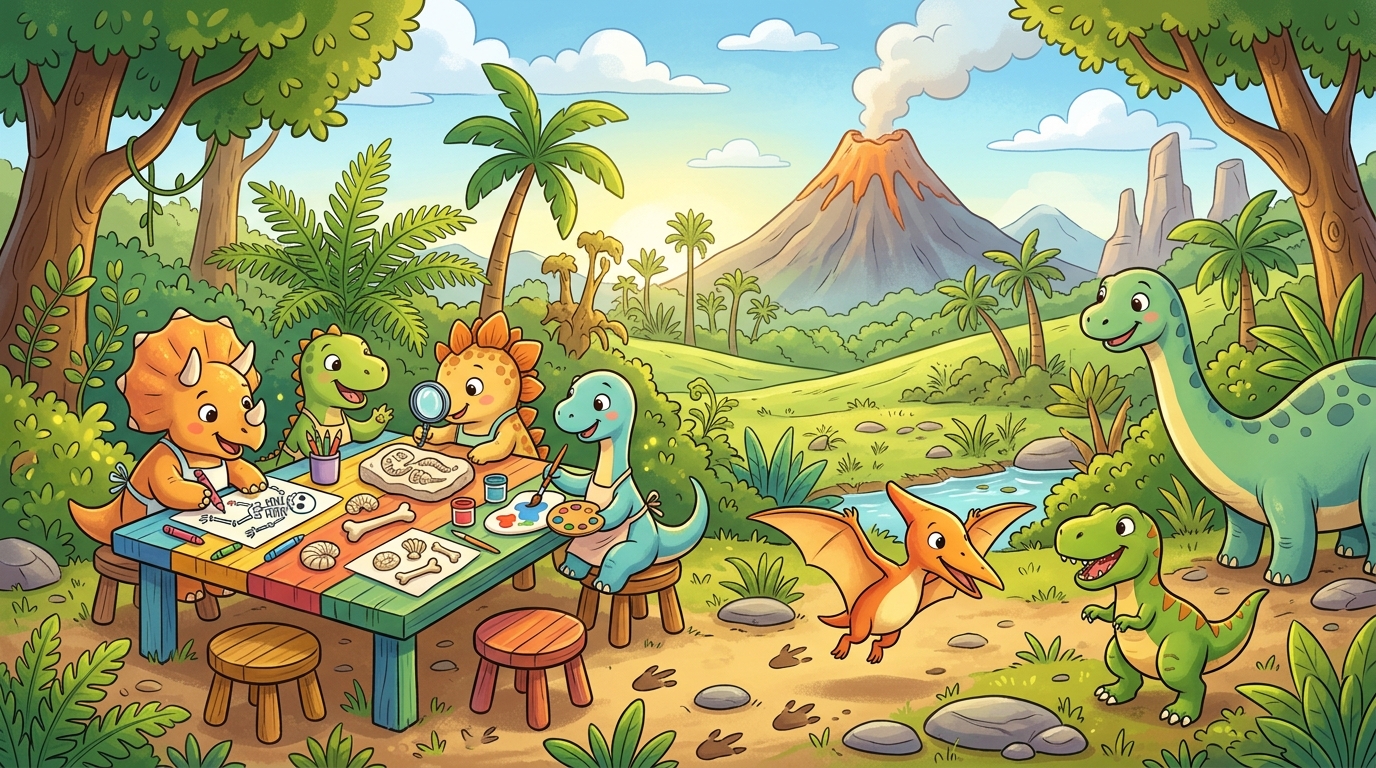
Turn Your Living Room Into an Excavation Site: The Paleontological Adventure Starts Here!
Have you ever dreamed of traveling back in time to walk alongside the mighty Tyrannosaurus or the graceful Diplodocus? If your children are fascinated by these vanished giants, why not turn your living room into a real excavation site? Organizing fossil workshops for kids is a fantastic way to combine scientific curiosity with artistic creativity. There's no need to head to the Gobi Desert to become an explorer: with a little imagination, a few simple tools, and our tips, you will offer your little paleontologists a memorable experience.
The world of dinosaurs is an endless playground for learning while having fun. In this article, we guide you step-by-step through setting up fun dinosaur activities that will capture your children's attention while teaching them fascinating facts about the history of our planet.
The Magic of the Past: Explaining Fossilization Without Complex Jargon
To make your fossil workshops for kids a success, it is essential to start with the basics: understanding what a fossil is. For a child, the concept of "millions of years" is abstract. The key is to use concrete images and visual aids.
How to explain fossilization simply?
Imagine a dinosaur that, a very long time ago, fell asleep by a river. After it died, it was covered by a lot of mud and sand. Over time, these layers turned into rock, and the dinosaur's bones turned into stone, just like the earth around them. This is what we call fossilization!
Did you know? Fossils aren't just bones! We can also find eggs, footprints, and even traces of fossilized skin or feathers. It's like a history book with pages hidden in the ground. 🦕
Visual tools for better understanding
To make this paleontology learning for kids more visual, don't hesitate to:
- Show photos of real excavation sites.
- Use diagrams showing the different layers of earth (strata).
- Compare the size of a fossil with an everyday object (like a shoe or a car) to provide a sense of scale.
DIY: Create Your Own Fossil Museum at Home
What could be more rewarding than touching your own discoveries? Creating imprints is one of the favorite fun dinosaur activities for children. It’s a great way to bring theoretical explanations to life.
The "Dinosaur Imprints" Workshop
For this activity, you will need salt dough or air-dry clay, and a few plastic dinosaur figurines.
Steps to follow:
- Roll out your dough into patties about 1 cm thick.
- Take the dinosaur figurines and press their feet or skulls firmly into the dough to leave a clear imprint.
- Let them dry in the open air or in the oven, depending on your dough's instructions.
- Once dry, you can even paint the fossils to give them an "old" and authentic look.
This part of the fossil workshops for kids helps develop fine motor skills while observing the morphology of feet and claws. It’s the perfect time for a discussion: why does this dinosaur have such long claws? Was it for walking in the mud or for catching prey?
Coloring as a Scientific Magnifying Glass: Observe to Better Understand
Dinosaur fossil coloring isn't just a simple distraction. It is a powerful educational tool for anatomical observation. While coloring, the child is forced to slow down and look at every detail of the skeleton.
Identifying key parts of the skeleton
When using our educational worksheets, encourage your child to name the body parts they are coloring. This turns quiet time into a real moment of paleontology learning for kids.
- The skull: Observe the shape of the teeth. Are they sharp (carnivore) or flat (herbivore)?
- The vertebrae: Explain that the spine is what allows the dinosaur to stand upright or run.
- The claws: Compare them to our own nails to explain their purpose in nature.
Fun fact: The name "Dinosauria" means "terrible lizard," but many dinosaurs were actually closer to birds than to modern-day lizards! 🦖
By incorporating dinosaur fossil coloring into your workshops, you help the child memorize bone structure while developing their patience and attention to detail. It’s the perfect activity to wrap up an afternoon of intense digging.
Becoming True Paleontology Experts!
Organizing fossil workshops for kids is an adventure that transforms the natural curiosity of the youngest into a true passion for science. Whether it’s handling clay or precisely coloring the details of a skeleton, every action brings your child closer to the fascinating world of paleontologists. Remember that learning is most effective when it is shared: don't hesitate to display your little explorers' masterpieces on the house's "discovery wall"!
Do you want to take your exploration further? We have prepared an exclusive collection of 'Budding Paleontologist' coloring sheets for you. These materials are designed to accompany your fun dinosaur activities and provide your children with hours of educational fun. Download our templates now and complete your paper fossil collection. Ready to get your pencils out and travel back in time? Quickly discover our complete library of dinosaur coloring pages and let the magic happen!