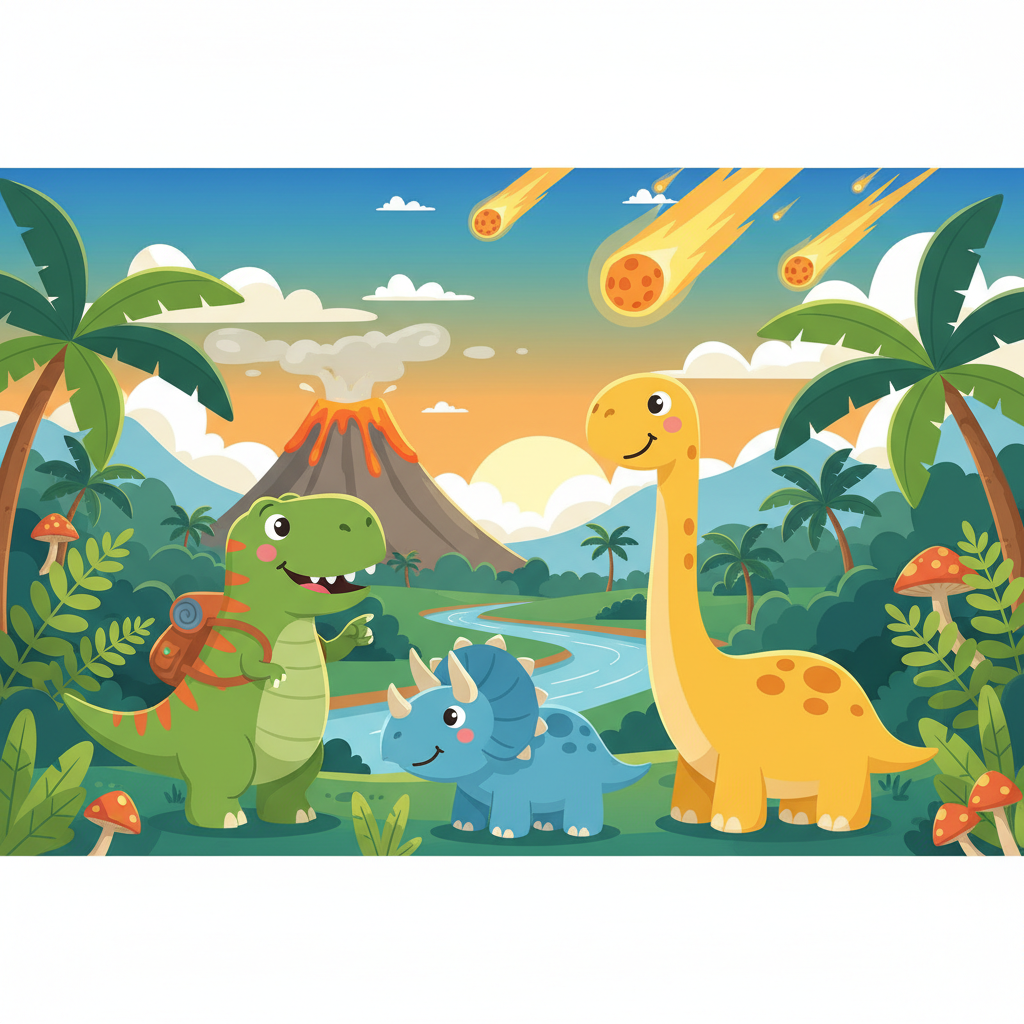
Imagine a world filled with incredible creatures, from giants that make the earth tremble to small, agile predators. This world existed, a very long time ago, and it was populated by... dinosaurs! But where did they go? Why did the dinosaurs disappear, even the young ones? This is a question that intrigues all little explorers, and we will try to answer it together. Get ready for a journey through time filled with discoveries and a little sadness, because this story has a somewhat melancholic ending... but also full of hope for the future!
🦕🦖A World of Giants: Once Upon a Time, Dinosaurs...🦖🦕
Millions of years ago, long before humans existed, the Earth was the kingdom of dinosaurs. From peaceful herbivores like the Brachiosaurus, with its long neck to reach the highest leaves, to formidable carnivores like the Tyrannosaurus Rex, with its sharp teeth, they reigned supreme!
Dinosaurs were incredibly diverse. They came in all sizes, shapes, and colors. Some were covered in feathers, others in scales. They lived in forests, deserts, swamps... everywhere!
Fun fact: Did you know that the smallest known dinosaur, the Compsognathus, was barely bigger than a chicken? And that the largest, the Argentinosaurus, was longer than a football field?
Very Different Dinosaur Families
- Herbivores: These dinosaurs ate plants. They include giants like the Diplodocus or armored dinosaurs like the Stegosaurus.
- Carnivores: These dinosaurs ate meat. The Tyrannosaurus Rex is the most famous, but there were also velociraptors, smaller but very fast.
- Omnivores: Some dinosaurs ate both plants and meat.
💥 The Great Catastrophe: The Story of the Asteroid 💥
Unfortunately, the story of the dinosaurs does not end well. About 66 million years ago, a cataclysmic event changed the course of life on Earth. A huge asteroid, larger than a mountain, crashed into our planet at incredible speed!
The impact was so violent that it caused earthquakes, giant tsunamis, and massive fires. A huge amount of dust and smoke was thrown into the atmosphere, blocking sunlight.
The Consequences of the Impact
Imagine the sun disappearing for months, even years! Plants could no longer photosynthesize, and herbivores starved. Then, the carnivores, who fed on the herbivores, also ran out of food. It's a terrible chain reaction that led to the extinction of dinosaurs, young and old.
Fun fact: The asteroid created a gigantic crater, the Chicxulub crater, which is now located under the Yucatan Peninsula in Mexico!
🌍 A Changing World: How Dinosaurs Couldn't Adapt 🌍
Why did the dinosaurs disappear, even the young ones, while other animals survived? The answer is simple: they could not adapt to the brutal changes in the environment. Dinosaurs were large animals that needed a lot of food and a stable climate to survive.
Small animals, like mammals (our ancestors!) and birds, needed less food and could hide more easily. They were therefore more likely to survive the disaster.
Size, a Disadvantage?
The size of the dinosaurs, which was an advantage when food was plentiful, became a major disadvantage after the asteroid impact. They needed too many resources to survive in a world that had become cold and dark.
🐦 The Survivors: Who Survived the Catastrophe? 🐦
Even though the most famous dinosaurs disappeared, life went on! Mammals, which were small, discreet animals in the time of the dinosaurs, took advantage of the opportunity to develop and diversify. They gave rise to all the mammals we know today, including humans!
And did you know that birds are actually the direct descendants of dinosaurs? Yes, yes, you heard right! Some small, feathered dinosaurs survived the extinction and evolved into the birds we see flying in the sky today.
Fun fact: The chicken is often considered the closest living relative of the Tyrannosaurus Rex!
🌱 Lessons from History: Why It's Important to Understand 🌱
Understanding why the dinosaurs disappeared, even the young ones, is important for several reasons. It shows us that life on Earth is fragile and that natural events can have dramatic consequences. It also reminds us that we must take care of our planet and biodiversity.
Today, we face another major challenge: global warming. Just as dinosaurs could not adapt to the changes caused by the asteroid, many animal and plant species are threatened by global warming. It is therefore our responsibility to act to protect our environment and ensure a sustainable future for all.
What We Can Learn from the Extinction of the Dinosaurs
- The importance of biodiversity: A diverse ecosystem is more resilient to change.
- The fragility of the environment: Natural events or human actions can have serious consequences.
- The need to adapt: Species that cannot adapt to change are threatened with extinction.
🖍️ Dinosaur Coloring Page: A Tribute to the Vanished Giants 🖍️
To remember these fascinating creatures and to let your imagination run wild, we offer you dinosaur coloring pages to download for free! You can color your T-Rex green, your Triceratops pink, or invent completely new colors for these giants of the past.
Let Your Imagination Run Wild!
Imagine you are a paleontologist discovering a new dinosaur skeleton. What colors would you give it? What would its name be? The possibilities are endless!
🚀 Conclusion: An Unforgettable Journey Through Time 🚀
We hope you enjoyed this journey through time and that you learned a lot about dinosaurs and why the dinosaurs disappeared, even the young ones. Remember that their story is a warning, but also a source of inspiration to protect our planet and biodiversity.
So what are you waiting for? Download our dinosaur coloring pages, dive into books and documentaries to learn even more about these incredible creatures, and above all, become an ambassador for the protection of our planet! Together we can make a difference!
Discover our magnificent dinosaur coloring pages now and let your imagination roar! 🦖🖍️